Offshore Wind Gains Despite Trump Trickery
Despite some technical and political challenges, offshore wind power continues to be a key opportunity for achieving a safe and sustainable energy future in the US, especially off the northeast and west coasts. During the Biden administration, ongoing planning for offshore wind farms led to a commitment for 30 gigawatts (GW) nationwide by 2030 – equivalent in capacity to 25 nuclear plants like Seabrook – with an additional 15 GW to be floated in deeper waters by 2035.
The federal Bureau of Ocean Energy Management (BOEM) went to work identifying and auctioning lease areas in federal waters off both the east and west coasts as well as the Gulf of Mexico. In total, about three dozen lease areas covering almost 3.5 million acres have been leased, with the potential to generate 19 GW and netting over $5 billion to the federal treasury. Then of course Trump 2.0 happened, and much of this promise got blown off the map – in some cases literally – with all federal permitting stopped and existing projects forced to be re-examined.
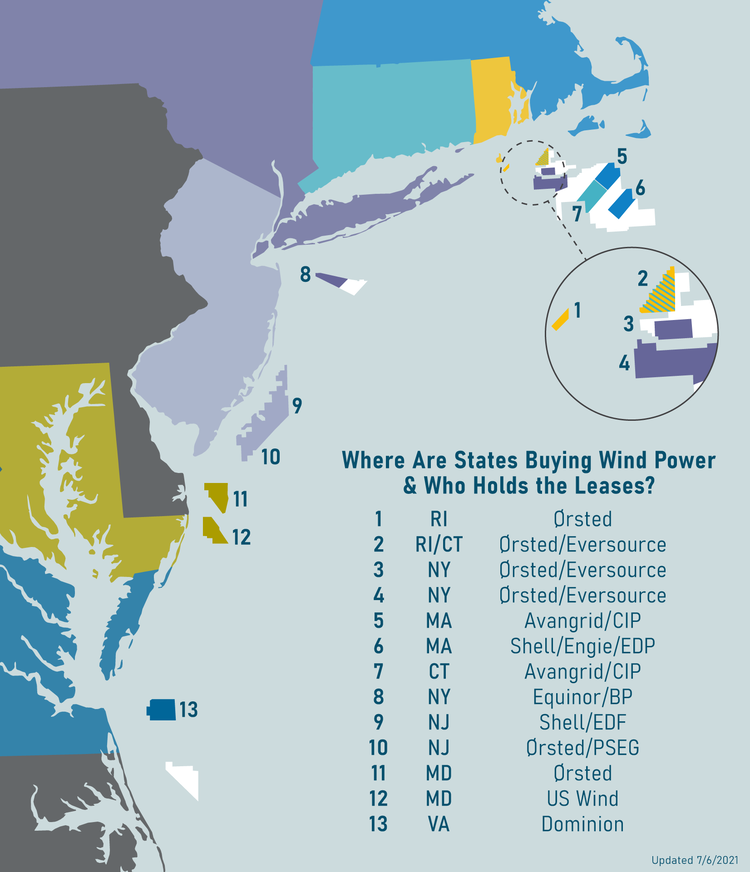
Nevertheless, there are currently about 57 turbines generating almost 600 MW of power off the southern New England coast, and by the end of next year there will be over 300 turbines and about 7 times that capacity operating off the entire east coast, with more to come online in following years. So despite Trump’s efforts to kill it, to paraphrase Mark Twain, “news of offshore wind’s demise has been greatly exaggerated!”
Thus far, two of Trump’s efforts to derail development of already permitted offshore wind farms – Empire Wind in NY and Revolution Wind in RI – were stopped by courts and/or their state’s governors. And there’s little mention in the mainstream media of the 4,000 MW of wind farms off the East Coast that are moving forward, with the biggest off Virginia, right under Trump’s nose. So it appears despite their ongoing legal efforts, offshore wind has momentum now that the naysayers can’t stop.
Ironically, Trump’s ongoing attempts to obstruct the growing US industry will likely convince some builders to move further offshore – to other countries – robbing the US economy of thousands of good jobs and lower electric rates, contrary to his supposed desire to “onshore” foreign economic activity.
Closer to home, despite the leasing of four commercial wind farm areas last year (see map below), totaling about 1/2 million acres and 6 GW potential (about FIVE Seabrooks!), Trump directed BOEM in July to “erase” the Gulf’s remaining designated wind energy area along with a dozen others around the country. That appears to put everything back to square one regarding any new leases. But since not all the Gulf leases offered last year actually sold, it may not matter in the near future since the floating technology needed in the deeper Gulf waters has not been standardized or employed in great numbers yet, so construction is still many years off at this point.
Relatedly, we recently witnessed the demise of New Hampshire leadership on offshore wind development, thanks to the NH House leadership’s retrograde thinking and abdication of regional reality by Governor Kelly Ayotte, following on President Trump’s head-in-the-sandtrap attitude. Back in 2020 the state, under prior governor Chris Sununu – as a result of great grassroots lobbying efforts – had taken the lead in northern New England by initiating a BOEM-required intergovernmental and multi-state task force for the Gulf of Maine. The legislature then created an offshore wind economic development office and commission to move things along, creating a detailed study of the benefits of offshore wind development and infrastructure needed to facilitate its utilization. That study concluded that offshore wind in the Gulf of Maine has the potential to produce enough power to fully meet the needs of New England states for nearly 40% of the year and that 3,600 jobs could be created in New Hampshire alone.
Yet earlier this year, the legislature approved and the governor signed legislation to do away with the state’s offshore wind development office and commission. This came despite the previous study having identified significant Gulf offshore wind supply chain and port facilities job opportunities in-state, and key potential “on-shoring” locations to connect to the regional power grid at either Seabrook or Portsmouth.
Still, the rest of New England is moving forward, suing Trump over his do-nothing offshore wind policy, and aiming to build more offshore power capacity in the next few years than Seabrook, Millstone and several existing fossil-fueled power plants currently provide.
Coupled with accelerated development of ever-cheaper solar power and utility-scale battery storage, offshore wind power development off New England’s and other coastal states’ shores has the potential to put us on the path toward true energy sustainability and climate sanity, but only if we can survive and overcome the Trump administration’s “drill-baby-drill” approach to energy development in the near term.
