PRAIRIE DOG ALLIANCE VS DEEP FISSION
Prairie Dog Alliance is a group of Southeast Kansas residents brought together by Marjorie Reynolds, a pediatric nurse, out of concern for a proposed project in Parsons, Kansas. She said, “Many in our community were not given a vote or a voice in this decision, and we believe it is crucial to inform and educate the public about the potential risks and impacts of this project.”
Deep Fission, a brand new company based in Berkeley, California, is planning to install an untested, experimental nuclear micro reactor a mile underground in the Great Plains Industrial Park. The company has no experience whatsoever with nuclear power as evidenced by the comments of Deep Fission CEO Elizabeth Muller explaining how both nuclear energy and nuclear waste are dense enough to fit into a Coke can.
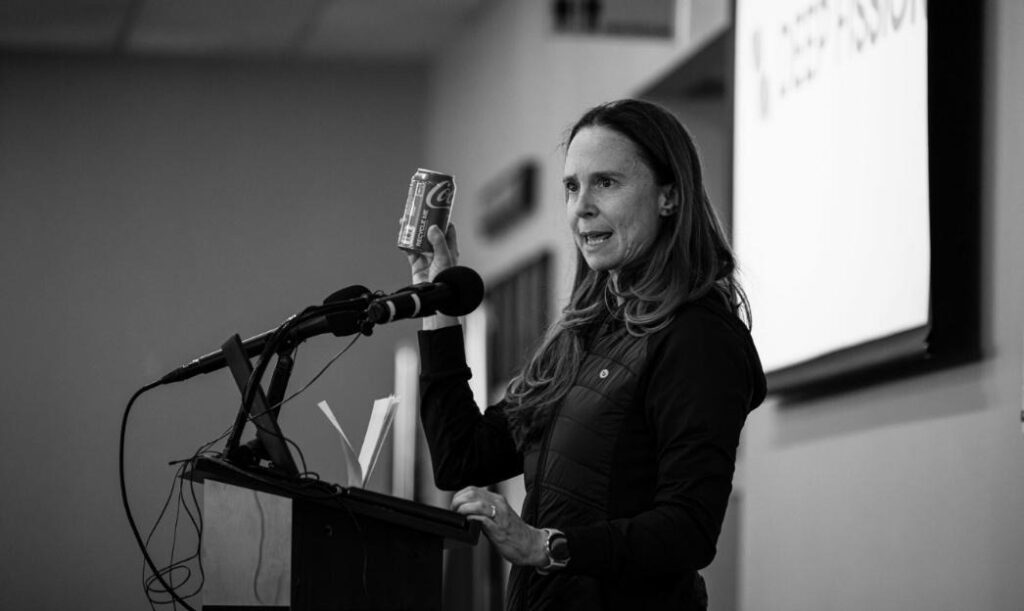
Sean Frye/Sun Photo/www.parsonssun.com/
BUILDING ALLIANCES
Meanwhile, PDA is building alliances and educating legislators, organizations, tribes and individuals. The Kansas Green Party posted this message and the photo below in March 2026 with Marjorie Reynolds:
“The Kansas Green Party had a great time at WEALTH Day 2026 (Water, Energy, Air, Land, Transportation, Health!) yesterday, sharing our table space with Prairie Dog Alliance to raise awareness about the risky experimental nuclear microreactor project in Parsons that suddenly broke ground last year.
Marjorie and her community in Southeast Kansas are doing an excellent job educating and informing the public about what Deep Fission plans for the site at Great Plains Industrial Park so please follow the PDA page to learn more and stay tuned as the coalition of watchdog organizations grows.”
Parsons in southeast Kansas is atop the aquifer flowing through the four corners of Kansas, Oklahoma, Arkansas and Missouri, a great concern for the Nine Tribes there.
On 3/23/26, Marjorie Reynolds posted this update:
I thank the Miami Nation for hosting Prairie Dog Alliance at an educational discussion with representatives for the nine tribes in northeastern Oklahoma.

Our Oklahoma neighbors to the south and downstream of Deep Fission’s project deserve better from Labette County elected and appointed officials. We don’t want an untested, experimental nuclear micro reactor contaminating our water, soil and air or theirs. The people of Labette County did not vote or consent to be bad neighbors. Labette County citizens want everyone to live in the Four States and not be afraid of nuclear contamination.”
DONATIONS TO PDA
Clamshell Alliance and Beyond Nuclear are allies of the Prairie Dog Alliance. To donate to Prairie Dog Alliance, you can send funds to the GoFundMe page Marjorie Reynolds set up here. If you are making a tax-deductible contribution, send a check to Beyond Nuclear 9PDA’s fiscal sponsor) with Prairie Dog Alliance in the memo line. Mail it to Beyond Nuclear, 7304 Carroll Avenue, #182 Takoma Park, MD 20912
THE DIRTY DETAILS
Beyond Nuclear wrote in Jan. 2026: Deep Fission is drilling a mile deep pilot borehole to sink the first-of-a-kind deep geological nuclear power station underground, and intend to go critical this July 2026. Instead of constructing the familiar mammoth and costly reinforced concrete nuclear accident containment structure, these smaller atomic power plants intend to rely upon the natural rock body itself for operational radiation shielding and isolating a potential nuclear accident from contaminating the atmosphere, the surrounding surface area and deep fresh water resources into an indefinite future.
These 15 megawatt electric (MWe) small modular pressurized water reactors (SMRs), identified as the “Gravity Reactor” would supply the high pressure super-heated steam to a turbogenerator facility on the surface co-located with a common control room for multiple units dropped into other individual boreholes. These reactors will not require refueling. Instead, each unit would operate for one fuel cycle (roughly projected for six years) before permanently shutting down, disconnecting the unit within the bore hole from the surface facility and then sealed shut in place deep underground. A new fueled Gravity Reactor would be lowered down the borehole and stacked atop the buried unit, connected to the surface turbogenerator and control room to resume power operations to the surface electrical grid.
NO SAFETY REGULATION, NO ENVIRONMENTAL CONSIDERATION
On March 11, 2026, Beyond Nuclear continued the story, and explains how the federal government’s unlawful safety exemptions for Deep Fission are being contested by 12 states’ attorneys general:
- Eleven state Offices of Attorneys General (AZ, CA, IL, MA, MD, MN, NM, NY, OR, WA, VT) and the District of Columbia say that DOE’s “categorical exclusion” to exempt “advanced reactors” from environmental reviews is “unlawful and arbitrary and capricious.”
- California Office of Attorney General Rob Bonta’s had this to say, “The words ‘exemption, exclusions’ and ‘nuclear safety regulations’ should never be used together. When it comes to nuclear energy and public safety, there should be more safety regulations and environmental protection, not less.”
- The Nuclear Regulatory Commission has licensing and regulatory authority, not the DOE. DOE exceeded its statutory authority.
- DOE failed to consider the potential environmental impacts of the “advanced nuclear reactors”, like Deep Fission, covered by the categorical exclusion.
- The categorical exclusion is unsupported by data showing that “advanced reactors” like Deep Fission do not have the potential to create significant environmental impacts.
- DOE shifted the environmental review of future “advanced reactors” from a public facing review to a purely internal examination.
NEWS COVERAGE
National Public Radio’s KPRS in Pittsberg, KS carried a story on March 25, 2026 (from reporting by Kansas News Service) which addressed the uncertainties related to the project. “Deep Fission is clarifying priorities for the company’s 1-mile underground nuclear reactor site in Kansas, saying the group is committed to drilling data acquisition wells in Parsons and completing a pilot reactor, but how the project will be commercialized isn’t clear yet.”

The Parsons Sun newspaper has been carefully covering the issue of Deep Fission’s dicey experiment and resistance to it. On 3/29/26 the editor said on their Facebook page that she was meeting soon with Deep Fission’s CEO and asked the public for questions.
She received this detailed message from Lou Martino:
Please address the following:
In Parsons, Kansas, the “deep fission” project at the Great Plains Industrial Park is a pilot program by the California-based startup Deep Fission. They broke ground in December 2025 and aim to have their first 15 MWe “Gravity” reactor achieve criticality by July 4, 2026. Because this technology involves placing a small modular reactor (SMR) in a 30-inch borehole one mile (1.6 km) underground, the potential hazards differ from those of traditional surface-level nuclear plants.
1. Geological and Drilling Hazards
Since the reactor is placed at a depth of 5,280 feet, the primary risks during the 2026 construction and testing phase involve the drilling process itself:
- Wellbore Instability: Deep drilling in Southeast Kansas involves passing through layers of limestone, shale, and sandstone. If the borehole walls are not properly stabilized (geomechanics), it could lead to “sloughing” or collapse during the insertion of the reactor module.
- Abnormal Pressure & Mud Loss: Drilling can encounter unexpected fluid pressures. “Lost circulation” (where drilling mud escapes into underground fractures) can stall the project or, in rare cases, create pathways for fluids to move between geological layers.
- Seismic Integrity: While the surrounding rock provides “passive shielding,” any natural or induced seismic activity must be monitored to ensure the 30-inch shaft remains perfectly aligned for the gravity-based safety systems to function.
2. Operational Safety (The “Gravity” Design)
The “Gravity” reactor uses a pressurized water design. The hazards here relate to the experimental nature of the deep-borehole setup:
- Coolant Circulation: The design relies on the weight of the water column (gravity) to provide the necessary pressure. A hazard unique to this setup would be a blockage or failure in the one-mile-long coolant loop, which could theoretically lead to overheating at the bottom of the shaft.
- Containment Failure: While the rock itself acts as a massive containment vessel, a breach in the reactor casing could potentially release radionuclides into the deep subsurface. However, at one mile deep, the reactor is far below the freshwater aquifers used for local agriculture and drinking water.
3. Environmental and Local Impact
- Radioactive Waste Management: Although the reactor is designed to stay underground, the long-term plan for the spent fuel must be addressed. If the borehole is used as a permanent “repository,” the hazard shifts to the long-term integrity of the borehole seals (over centuries).
- Thermal Pollution: Deep reactors generate significant heat. Engineers must ensure that this heat dissipation through the rock doesn’t adversely affect the local subsurface environment or cause thermal expansion that could damage the shaft.
- Surface Infrastructure: In 2026, the primary visible hazard will be typical of any heavy industrial site: increased truck traffic at the industrial park, high-voltage electrical connections, and the handling of specialized drilling equipment.
Summary of Risk Mitigation according to Deep Fission
Deep Fission argues that this method is inherently safer than surface plants because:
- It is unreachable by aircraft or most surface-level terrorist threats.
- The high pressure of the deep earth prevents the water from boiling away easily.
- The “billions of tons” of surrounding rock provide a natural barrier that surface domes cannot match.
If you are following the project closely, the July 2026 criticality goal will be the major milestone to watch, as it will prove whether the gravity-pressurized system can maintain a stable nuclear reaction at that depth.